


If you’ve been researching outdoor upgrades, you’ve probably run into the word hardscape without a clear sense of what it actually covers—or why it matters so much in this part of Colorado specifically. This guide breaks hardscape landscaping down, covers the most common features homeowners in Monument and North Colorado Springs ask about, and explains what makes hardscape installation here different.
The Short Answer
Hardscape is the non-living portion of your landscape: the patios, walkways, walls, driveways, fire pits, and structures that give your yard its bones. It’s what your furniture sits on, what defines the edge of your lawn, what holds your hillside in place, and what guides people from your driveway to your front door.
The short answer is easy. The more useful answer is understanding why hardscape (not plants, not lawn, not decorative rock) is usually the right place to start when you’re planning a meaningful outdoor upgrade. Plants grow and change. Grass needs constant maintenance. But well-built hardscape sets the structure everything else lives around, and it either works or it doesn’t for the next 20 years. Get it right and it becomes invisible in the best way. Get it wrong and it’s expensive to undo.
What Monument and North Colorado Springs Actually Demand from Hardscape
This is where the conversation changes compared to the generic hardscape content you’ll find online, most of which is written for climates that have nothing to do with life at 6,500–7,200 feet on the Palmer Divide.
Frost Depth
Colorado’s frost depth along the Front Range runs roughly 36 inches—meaning the ground freezes that deep in a hard winter. Any footing for a pergola, retaining wall, or structural column needs to go below that line or you’ll see movement and cracking as the ground heaves and settles. Monument sits higher than most of the metro, which means colder overnight temperatures and more pronounced freeze-thaw cycles, especially in shoulder seasons when you can swing 50 degrees in a single day.
Expansive Soils
Much of this corridor sits on clay-heavy soils that absorb water, swell, and then shrink as they dry out. This cycle puts pressure on anything sitting on or in the ground. Base preparation isn’t just a best practice here, it’s load-bearing insurance. Skimping on base depth is the single most common reason hardscape fails prematurely in this region.
Drainage
Monument and North COS get enough elevation-driven precipitation, snowmelt, and occasional heavy summer storms that water management has to be designed in, not retrofitted. A patio that slopes slightly toward the house, a retaining wall without drainage aggregate behind it, or a driveway apron that channels water toward a foundation—these are problems that compound over time. Proper drainage design during installation prevents structural damage, erosion, and the kind of moisture issues that affect basements and foundations years down the road.
UV and Material Degradation
The UV index at this elevation is higher than most of the country. Composite decking fades faster than manufacturer specs suggest. Certain sealers and stains break down quicker. Natural stone and concrete pavers tend to hold up better than organic materials over the long term, and color selection matters more here than it would at lower elevations—lighter, neutral tones tend to retain their appearance better than dark-stained surfaces that bleach unevenly.
The Most Common Hardscape Features
Patios
A patio is usually the starting point for any serious outdoor living project, and the material choice matters more than most homeowners realize going in.
- Concrete pavers are the most popular option in this area for good reason—they’re durable, available in a wide range of styles and colors, and critically, they handle freeze-thaw movement better than poured concrete because the joints between individual units can flex slightly without cracking. Poured concrete will crack; the question is whether those cracks are controlled and cosmetic or running through the middle of your patio. Pavers sidestep most of that risk.
- Natural flagstone like Colorado buff sandstone, quartzite, or bluestone, gives a more organic look that tends to read as higher-end and ages beautifully in this landscape. It’s a good choice if you want something that looks like it belongs here rather than something that was shipped in. The tradeoff is cost and the need for skilled installation; irregular stone requires more labor to set properly than modular pavers.
- Exposed aggregate concrete is a solid mid-range option that hides weathering better than smooth concrete finishes and provides better traction when wet.
For any patio at this elevation, plan for a minimum 6-inch compacted gravel base, proper slope away from structures (typically 1–2% grade), and edge restraints that keep the field from migrating over time.
Walkways and Pathways
A well-designed walkway does more than connect two points. It creates the sense that a yard was thought through rather than just assembled. A 4-foot-wide pathway feels natural for two people walking side by side; narrower than that starts to feel like an afterthought.
In Monument and North COS, walkways that connect to driveways or approach front entries need to account for snowmelt. That means avoiding surface textures that trap ice, considering slight crowning to shed water, and thinking about where water will go when snow melts on a sunny February afternoon.
Stepping stone paths through planted areas are a lower-cost option that can look great, but they require a stable, level set. When you have stones that rock underfoot, they are a trip hazard and a frustration. Setting them properly takes more effort than it looks.
Retaining Walls
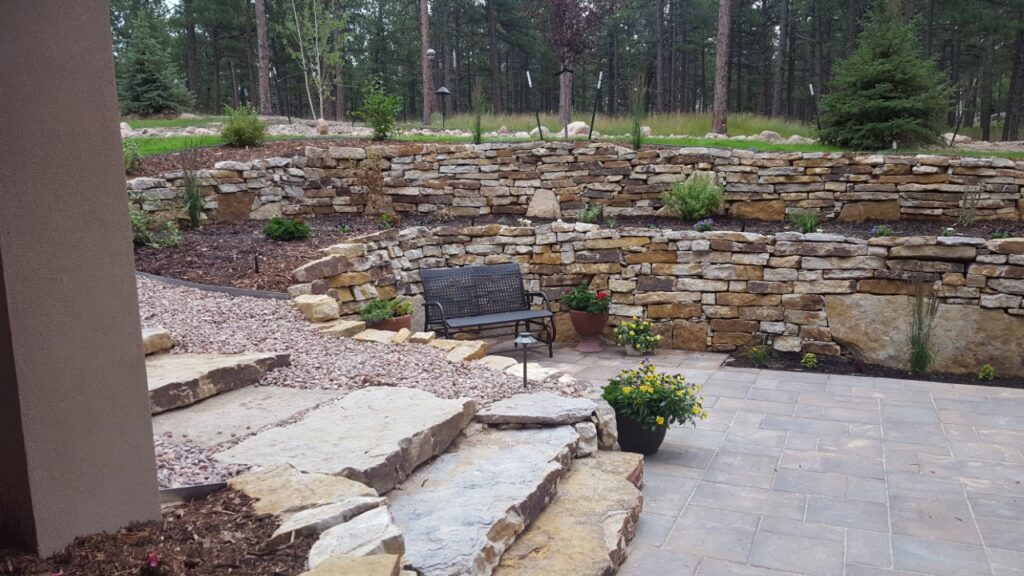
If your property has any meaningful grade change, a retaining wall isn’t just aesthetic, it’s functional. Walls hold soil in place, create level usable areas on sloped lots, and when done right, can become one of the most visually interesting elements in a landscape.
What’s behind the wall matters as much as what’s in front of it. Properly built retaining walls have compacted gravel backfill, drainage aggregate, and often a perforated drain pipe at the base to relieve hydrostatic pressure. A wall without this drainage system is storing water pressure that will eventually push it over or cause it to bow and lean. This is an area where cutting corners on materials is a false economy.
Wall height matters too. In Colorado, walls over 4 feet typically require a permit and engineered plans. Any wall near a property line has its own set of setback considerations. But these are all reasons to work with someone who knows the local requirements.
Fire Pits and Outdoor Fire Features
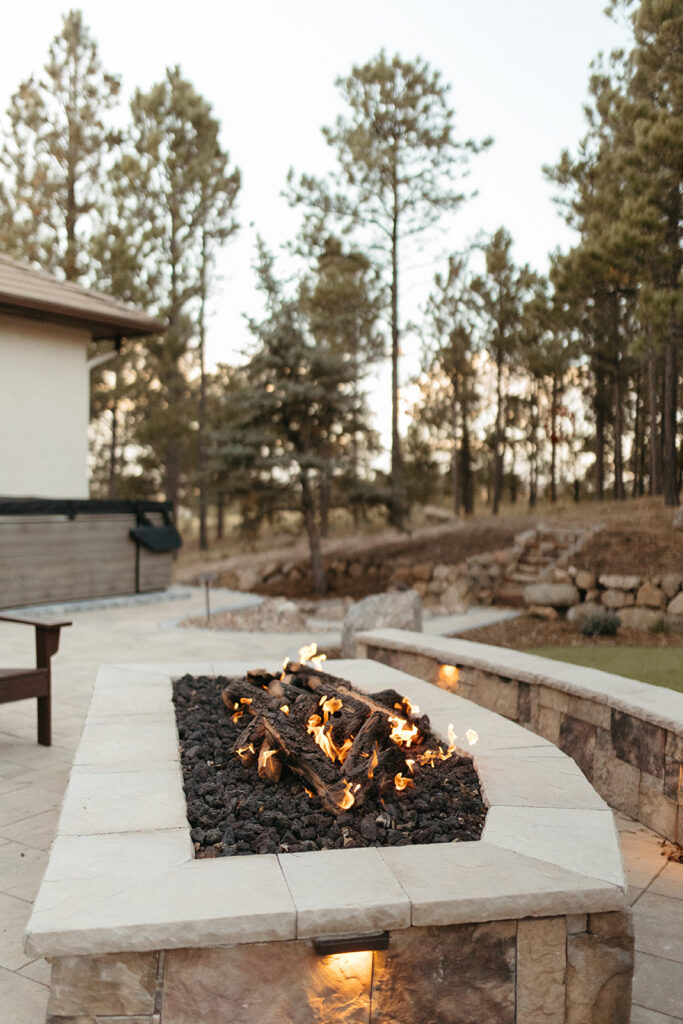
A fire feature is consistently the hardscape element that generates the most actual outdoor use in Colorado, and it makes particular sense when you live where evenings cool down quickly even in summer. A well-sited gas fire pit with a stone surround can extend comfortable outdoor use from roughly 4 months to 8 or 9.
The siting matters: fire features should be positioned away from overhanging trees or structures, oriented relative to prevailing winds, and placed with enough clearance that smoke doesn’t drift toward the primary seating area or into the house.
Wood-burning fire pits have a different atmosphere than gas but come with practical considerations—HOA rules, El Paso County fire restrictions (which can go into effect during dry conditions), and air quality action days when open burning isn’t permitted. Gas eliminates those variables.
Driveways and Paver Installations
A paver driveway costs more upfront than asphalt or plain concrete, but it holds up better over time, is significantly easier to repair, and adds measurable curb appeal. In a neighborhood context where most driveways are standard asphalt, a paver driveway is a meaningful visual differentiator.
For Monument properties where snowplows are a consideration, paver joints need to be tight enough that plow blades don’t catch. This is a detail worth discussing with your installer if it applies to your property.
DIY vs. Professional Installation: The Real Trade-Off
Some hardscape work is genuinely approachable for experienced DIYers, like small stepping stone paths, simple gravel areas, basic edging. But most of the projects above fall into a category where the work that determines whether it lasts is the work you can’t see once it’s done.
The base preparation under a patio, the drainage behind a retaining wall, the footing depth on a pergola post—these are the decisions that separate a project that still looks great in 10 years from one that’s settling, cracking, or failing in three. By the time you can see the problem, it’s already expensive to fix, and fixing it often means tearing out the finished work on top.
The other practical consideration: most meaningful hardscape projects in El Paso County require permits. Site grading, structural walls, fire features tied to gas lines, and electrical for lighting all have their own permit and inspection requirements. A professional contractor navigates that process as a matter of course; a homeowner doing it for the first time is starting from scratch.
None of this is an argument against being hands-on with your own property. It’s an argument for knowing which parts of the project are worth the risk and which ones aren’t.
We Help You Plan Your Project from Beginning to End
At Paradise Outdoor Design and Landscaping, we work with homeowners throughout Monument and North Colorado Springs on hardscape projects from single-feature installations to full outdoor living redesigns. We’re familiar with the specific soil conditions, permit requirements, and climate demands of this area, and we design and install to last.
If you’re ready to start planning, reach out to schedule a consultation. We’ll walk your property, assess the conditions, and put together a plan built for where you actually live.